
Meet the Pawpaw: America's Forgotten Tropical Fruit
Banana custard. Mango sunshine. A hint of pineapple drifting through the woods of the Midwest. The pawpaw is a fruit that feels almost invented, yet Asimina triloba has quietly grown across North America for centuries, tucked along creek beds and forest edges from Kansas City to the Chesapeake Bay. In this guest contribution, Andra Nus of Sleepy Gap Pawpaws shares what makes pawpaws so remarkable, from their prehistoric pollinators to the patience required to grow them well. Whether you’re curious about planting your first tree or dreaming of homemade pawpaw ice cream, this guide offers a practical and deeply personal look at one of America’s most fascinating native fruits.
Want to learn more about The Giving Grove straight from your inbox? Consider subscribing to our quarterly newsletter!
Contributed by Andra Nus, Sleepy Gap Pawpaws
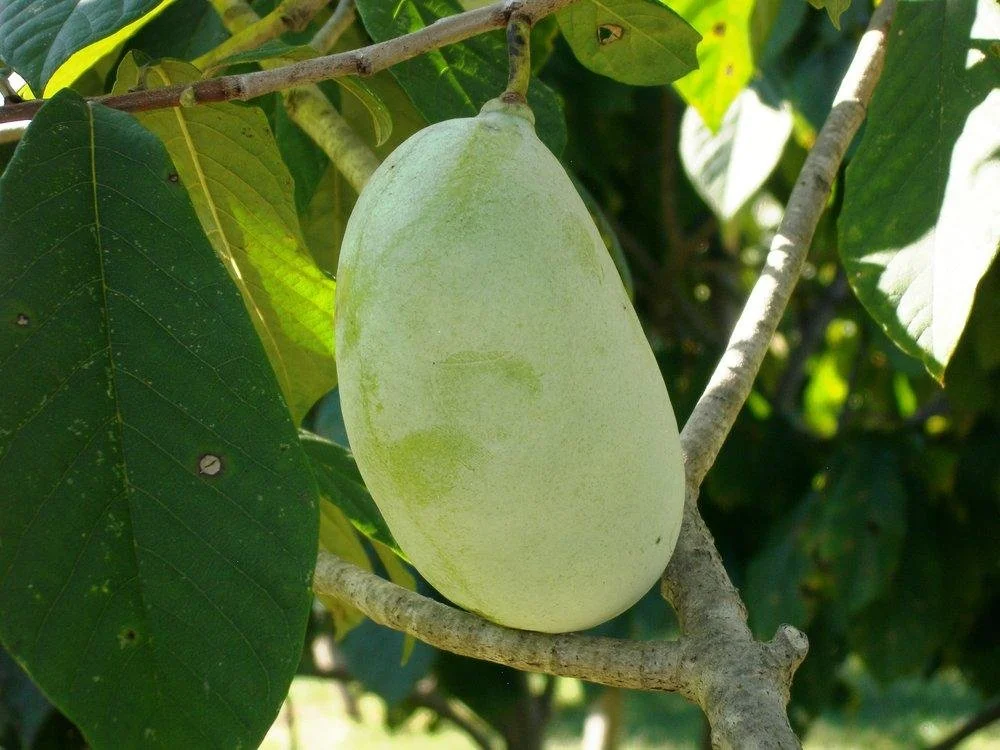
Pawpaw hanging from a tree. Credit: Andra Nus
Maybe you’ve heard about the wonderful pawpaw tree? Asimina triloba is our native North American pawpaw, with a range that extends from Michigan down to Alabama, and from Kansas City to the Chesapeake Bay. This understory tree commonly grows in wooded areas, along rivers and streams. It bears oblong-shaped, green fruits that are three to six inches long and the yellow-orange pulp has a marvelous tropical flavor, much like a banana, mango, or pineapple.
Planting and Establishing Pawpaw Trees
Though pawpaws grow naturally in shade, they also grow well in a full sun setting in an orchard. Pawpaw trees will flower and fruit better when planted in full sun. If you are planting in a garden setting, be sure to give trees as much sun as possible and good air circulation. They are not particular about soils but do not like to be planted in soggy situations. The long taproot will grow deep for water and nutrients, so be careful not to damage the taproot when planting and dig deeply to accommodate the taproot. Water the first year of establishment, add compost and mulch, and be patient. Often pawpaw trees are slow to establish and take root.
For best fruit production, plant two pawpaw trees. This could be two different cultivars, two different seedling trees or a combination of the two. And did you know that pawpaw flowers are pollinated by flies and beetles? These insects are attracted to the red unscented flowers that resemble the color of raw meat. Evolutionarily, pawpaw trees existed before bees and butterflies, and needed to be pollinated by the more primitive flies and beetles. Zebra swallowtail butterflies are dependent on pawpaw trees as a larval food source, but the adults will not pollinate the flowers.
Pawpaw flowers can be hand-pollinated as a means to increase fruit production. Pawpaw flowers are perfect, meaning they have both female and male parts in one flower. The stigmas of the flowers develop before pollen develops so cross-pollination between two flowers is necessary. You can take pollen from one flower with a small paint brush, and transfer that pollen to another flower that has a shiny stigmatic surface. And you, too, can be a fly!
And the best part? Harvesting!
Harvesting and enjoying the fruit is the best part of all! Fruit ripens for a long season, from mid-August to October, depending on the cultivar. Born singly or in clusters of up to 8 fruit, pawpaws are soft to the touch when ripe. If picked before they are soft, fruit will not ripen off the tree. Sometimes one fruit in the cluster is ripe when the others still need a bit longer to ripen, so pick carefully and test each fruit individually. Fruit also bruises easily. Pawpaws do not have a long shelf life when stored at room temperature - they will last 2-3 days on the counter, but if refrigerated, they can last more than two weeks. For best storage potential, process fruit by scooping the fruit from the skin, removing the seeds, pureeing the fruit, and freezing in a plastic freezer bag. Fruit also oxidizes quickly, like an avocado, so squeeze the air out of the freezer bag before putting it in the freezer. My favorite way to enjoy pawpaw is by making ice cream! Frozen fruit works well for this, and you can also use frozen fruit as you would use bananas in any recipe. Pawpaw bread and pawpaw cheesecake are splendid!
About the author
Andra Nus: I have been growing pawpaws in the Sleepy Gap Pawpaws orchard for 6 years now, and it has been a joy! Our orchard started first, and we now have 150 trees of 24 cultivars. The nursery began the following year, as the grafted varieties were difficult to find. We now graft hundreds of trees each year, beginning in April, and we sell the trees in August and September when the grafts have taken. Visit our website at www.sleepygappawpaws.com for more information and to sign up for email updates. Watching the trees grow, develop and gain maturity in our orchard and nursery has been a wonderful process. While it can be difficult to find grafted trees of known cultivars, it is worth seeking out and cultivating pawpaws for the pleasure of the harvest.