Pruning to an Open Center
If you’ve been trained in traditional arboriculture, some common fruit tree pruning practices can feel a little uncomfortable. Cutting back a young tree dramatically? Removing a significant portion of the crown year after year? Keeping a tree intentionally low instead of letting it reach its natural form? For most trees, these practices might raise some eyebrows. Fruit trees, however, are managed with a different goal in mind.
In this piece, originally written for an upcoming International Society of Arboriculture chapter newsletter, Fred Conrad, certified arborist and Giving Grove program manager with Food Well Alliance in Atlanta, explores why pruning fruit trees to an open center sometimes requires arborists to rethink a few familiar rules. With a little humor and a lot of practical experience, Fred explains how thoughtful pruning can create strong scaffold branches, bring light into the canopy, and, most importantly, keep the fruit where people can actually reach it.
Want to learn more about The Giving Grove straight from your inbox? Consider subscribing to our quarterly newsletter!
Contributed by Fred Conrad, Certified Arborist and Giving Grove Program Manager at Food Well Alliance
Fruit trees serve a different purpose. (Obviously.) And they are needy, on every level and in every sense of the word. You’ve never met a Tulip Tree that could out-needy a fruit tree. You’ve never met an Oak tree with as many parasites, an Elm with as many diseases, or a Sassafras that is so sought out by deer, raccoon and bear as a good fruit tree.
Let’s just zero in on pruning, and ignore soil micronutrients, specialty equipment and spray regimens for a moment. The problem is that what the fruit tree wants and what we want from the fruit tree are two different things. A fruit tree’s biological destiny is to grow into a tangled dome of bug-infested foliage, with narrow branch crotches with included bark, to become resplendent with water sprouts, and eventually develop into a small grove of genetically cloned infertile trees suckering up like crazy from the rootstock. It’s who they are.
Day 1: Show the tree who is boss. You get home with your new fruit tree, a 6’ whip of sapling that resembles, more than anything, a long fishing pole. Dig a nice hole, unwrap the roots, pop them in, backfill, mulch and water. But you’re not done yet. Or if you are done, you’re also doomed (see above). Pull out your Felco #2’s, give them a few test squeezes, close in on that apple tree, bend way over, and head that twig off at about the 24” mark. Your pie-eating family will thank you later, but when they look out the window and see you throwing the top 2/3s of your new tree into the chipper, they may be thinking something else.
That initial heading cut is everything. That cut will cause the tree to grow the low, well-angled, sturdy branches that will bear the weight of fruit. That cut results in the first tier of the scaffold branches that spread out and present fruiting branches that you can examine, prune, spray, and harvest from while your feet are firmly on the ground. The tree will grow a new leader. Give it another two or three feet and do the same thing again. Second tier, a little higher, a little narrower, but still wide and strong, with branches departing the trunk nearly horizontally for the first few feet.
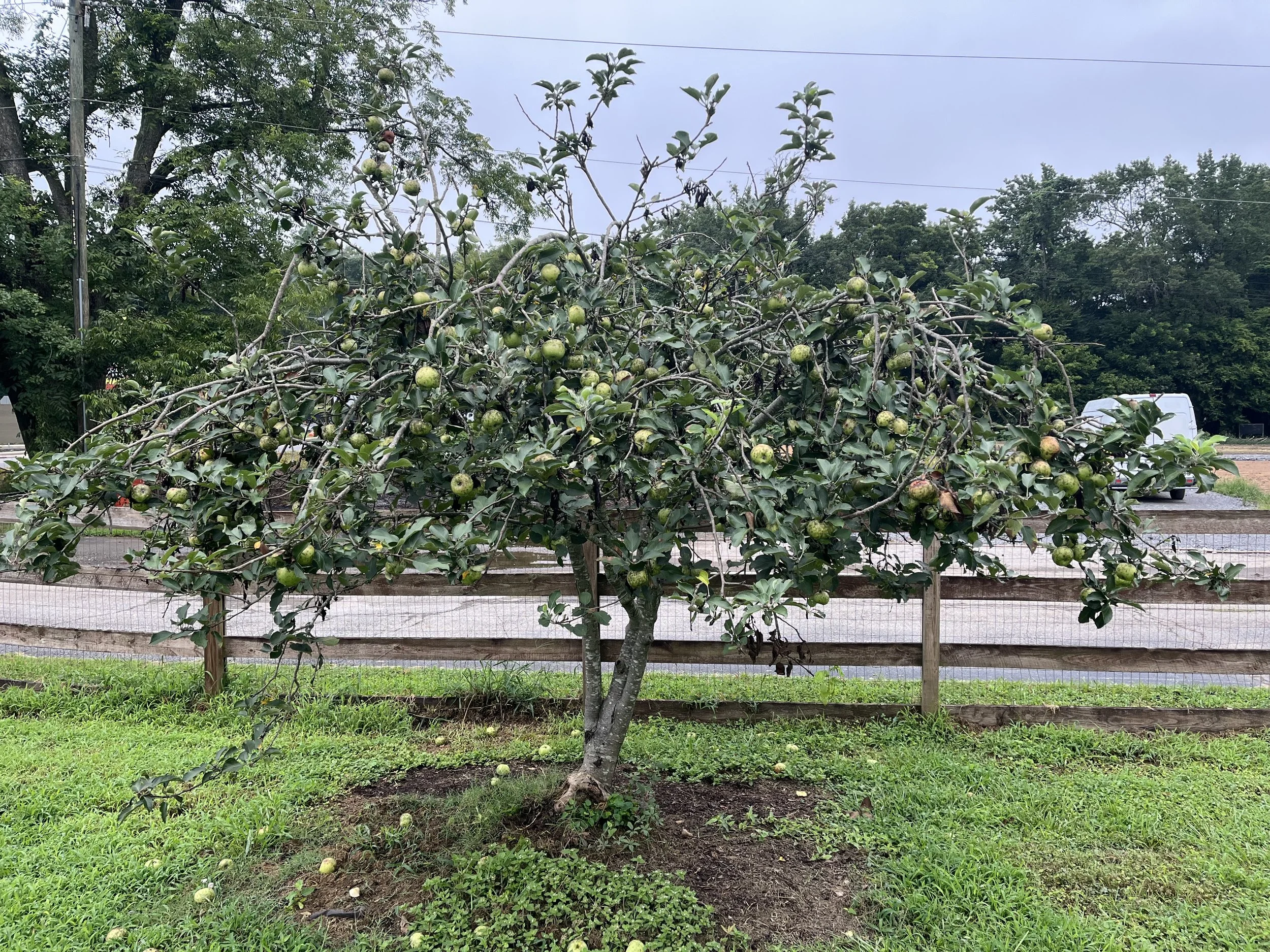
You’ve undoubtedly pruned a lot of trees. There may be trees you’ve worked on a couple of times (think power lines!). Now you’ve got a tree that you will prune every year, twice a year more likely. Because of the fruit. Because of that OTHER purpose.
Because fruit trees need an open center to develop the fruiting spurs that serve the purpose we have in mind for them. And, because bright ambient light inside the crown is needed for the development of fruiting spurs.
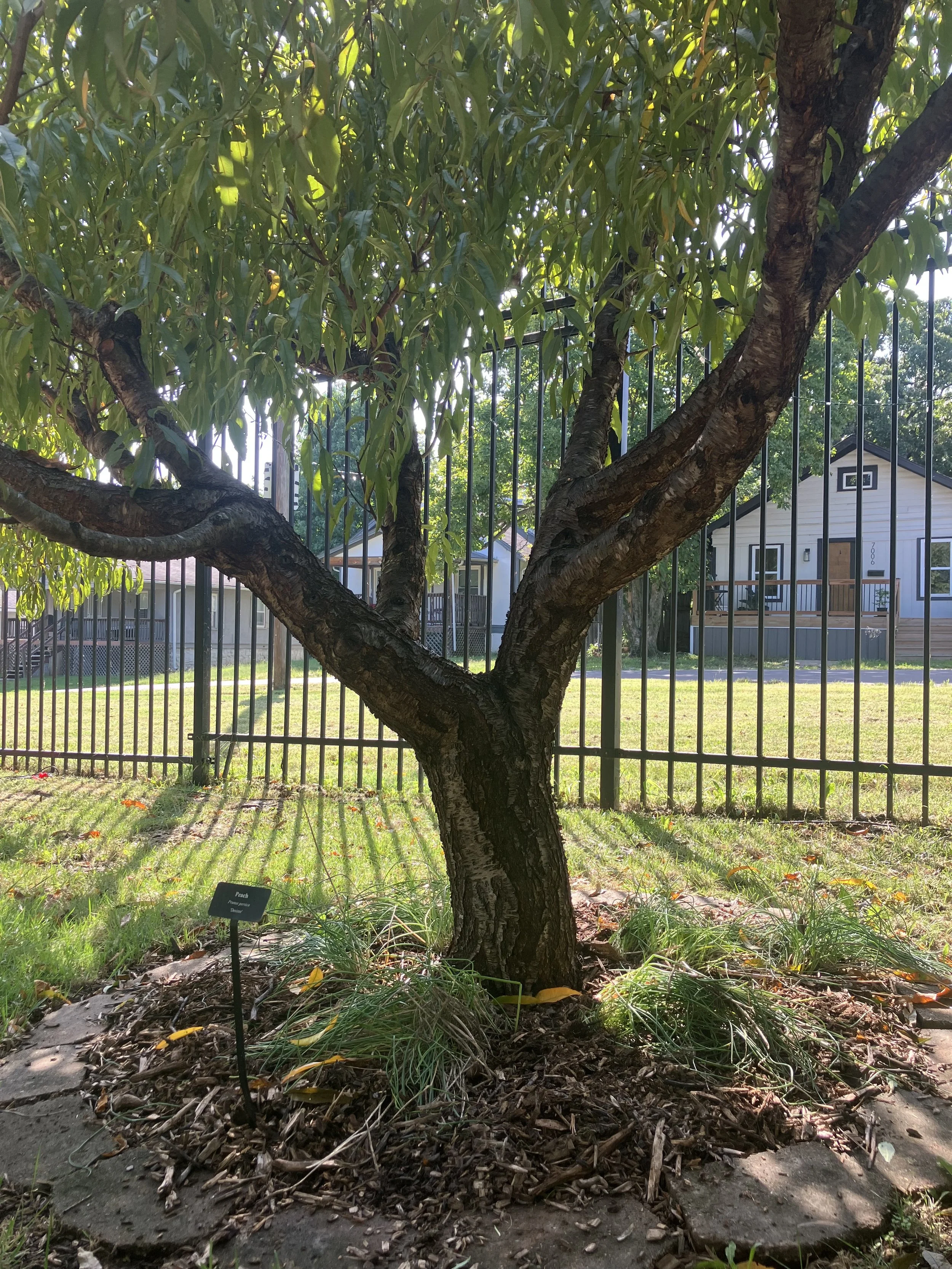
It’s not uncommon to remove ⅓ of a fruit tree's crown every year, and for stone fruit like peach and nectarine, that could go north of ½. A lot of that pruning will be in the middle of the crown, thinning cuts for watersprouts and crossing branches, and heading cuts for vertically inclined branches, and cuts to manage limbs that are long and unbranched. It’s easier to sculpt a tree in the winter when it is free of foliage, and you can more clearly see the shape and pattern of the scaffold. Aggressive dormant pruning can sometimes result in aggressive regrowth, so in order to control the size of the tree, summer solstice pruning is a common follow-up, especially for pome fruit like apples and pears.
For an arborist, some of these instructions can feel wrong. You have likely spent your career learning not to top trees and not to remove large portions of a healthy crown without good reason. But remember where we started: fruit trees serve a different purpose.
We aren’t managing trees to become the biggest, tallest or most structurally impressive versions of themselves. We are managing them to produce fruit and to put that fruit where people can reach it. That means keeping the crown low, open and full of light. It means creating strong scaffold branches capable of carrying a crop. And it means returning with our pruners, year after year, to keep the tree from becoming exactly what it wants to become.
Sometimes, good fruit tree care requires an arborist to rethink a few arborist rules. The cuts may feel aggressive, but the goal is different, and so is the tree. Keep it low. Keep it open. Keep the light coming in and the fruit within reach. Your pie-eating family and neighbors will thank you later!
About the Author
Fred Conrad has managed community garden programs in metro Atlanta since 1997, providing technical support, training, funding, volunteer coordination, and other resources to neighborhood food gardens across the region. Each year, his work directly supports 125 to 150 autonomous community gardens, and he has personally been a member of five community gardens. Fred serves on the board of the American Community Gardening Association, where his work has connected him with community gardens and urban growers across North America. He also holds a certificate in Horticultural Therapy and has been a Certified Organic grower, and is a certified Arborist.