
Growing a Tiny Army of Tree Huggers
At one Kansas City school orchard, a new after-school environmental club called Green Team helped students move beyond simply enjoying the orchard to actively stewarding it. What began as an effort to help protect a beloved orchard during upcoming construction projects quickly became something bigger: an opportunity for children to develop responsibility, pride, and a lasting connection to the trees growing in their community.
Want to learn more about The Giving Grove straight from your inbox? Consider subscribing to our quarterly newsletter!
Written by Sarah Sikich, Director of Marketing & Communications
For 13 years, I’ve watched the Giving Grove orchard across the street grow, thrive, and become a neighborhood hotspot for picnics (excellent) and tree climbing (slightly less excellent).
The orchard sits beside an elementary school that was shuttered for nearly five years due to low enrollment. During that time, the school grounds and orchard became an anchor point for our neighborhood. Even now, if the weather hits that perfect Midwestern 75 degrees, I can look out my window and count on seeing families gathered there: kids riding bikes, basketball games in full swing, hide-and-seek weaving through the playground, and picnic blankets spread beneath the fruit trees.
For the past six years, I’ve been a co-steward of that orchard space, a volunteer role I’m immensely proud of. Professionally, I serve as Director of Marketing for The Giving Grove, but just as importantly to me, I help steward the first Giving Grove orchard.
The only constant is change
So imagine my reaction when I learned the orchard might be partially removed during upcoming school construction projects.
Our school district recently passed a historic bond measure to fund desperately needed improvements to school buildings, including the elementary school next to our orchard. While I won’t dive too deeply into the long political back-and-forth that followed, I was genuinely surprised to discover that not everyone viewed mature fruit trees as essential community infrastructure. Some plans included replacing orchard space with astroturf and decorative concrete “trees.”
That moment made something very clear to me: if we wanted these trees to remain part of the school community long term, the students themselves needed to feel connected to them.
So we started Green Team.
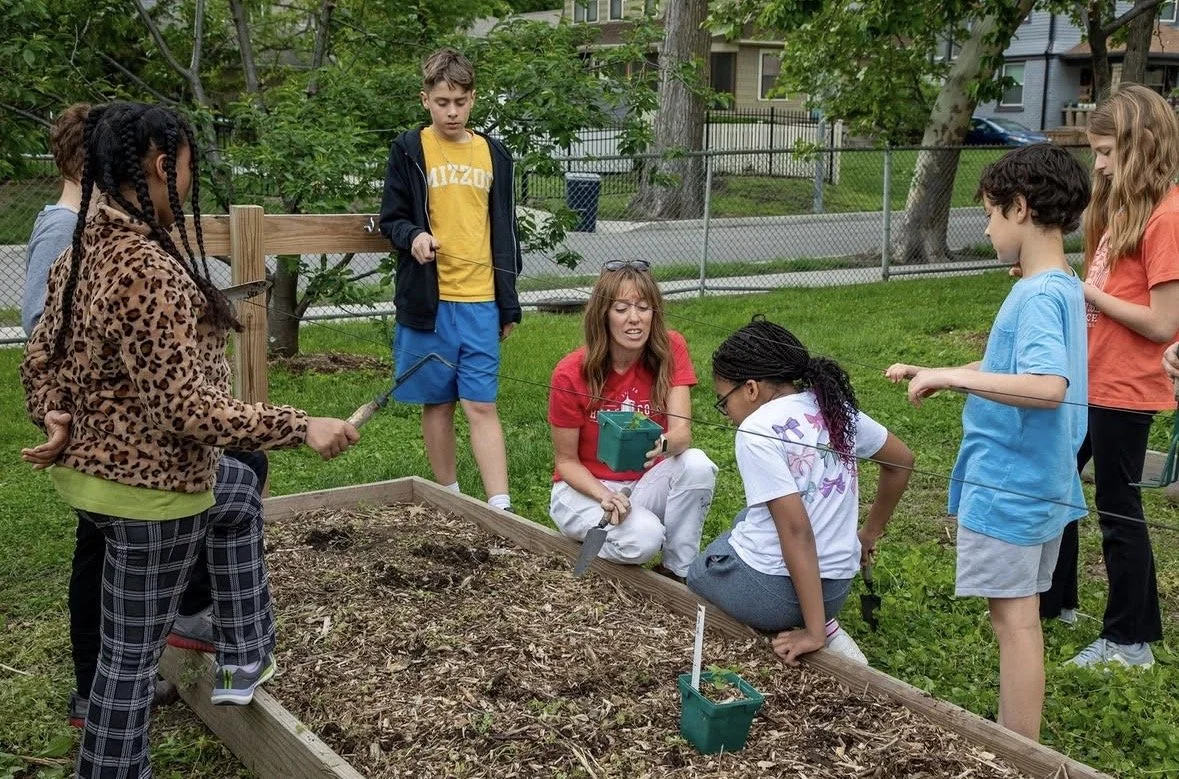
Green Team is an environmental after-school club focused on gardening, orchard care, and environmental stewardship. Alongside my co-steward, Aviva, I spent this past semester working weekly with more than 60 elementary students, rotating between younger and older grades for hands-on activities in the orchard and garden.
What happened next was incredible to watch. The students didn’t just enjoy the orchard. They became invested in it. The moment we announce we’re heading outside to work in the orchard, kids race to line up first. They want jobs. They want responsibility. They want to help care for something real. And when given the chance, they rise to meet it.
One third grader has essentially appointed himself junior orchard manager. He now visits the orchard regularly outside of Green Team meetings and recreates many of the stewardship tasks we practice together. Recently, while walking back into the building, he proudly told me, “I’ve been thinning the fruit all week. We’re going to have a great harvest this year.” A few months ago, he simply knew there were fruit trees on school grounds. Now he sees himself as someone responsible for helping those trees thrive.
That kind of transformation matters.
We often hear that kids are disconnected from nature or uninterested in outdoor work, but I’ve found the opposite to be true. When children are invited into meaningful stewardship, they respond with enthusiasm, curiosity, and an incredible sense of pride. They begin to see these spaces not as scenery, but as something worth caring for and protecting. And honestly, that may be one of the most important forms of long-term orchard stewardship there is. Yes, the trees provide fruit. Yes, they create shade, beauty, and gathering space. But when young people form relationships with these orchards, the impact stretches much further into the future.
Because children who help care for fruit trees today grow into adults who will fight to protect them tomorrow.