
What Neighbors Taught Us About Health, Right Outside Their Door
Last year, we paused to listen more closely to the people who experience Giving Grove orchards firsthand. Through a pilot survey of orchard visitors in Kansas City, neighbors helped us better understand how health shows up when fruit trees are planted where people already live. What they shared affirmed a simple truth at the heart of The Giving Grove’s work: when orchards are part of a community, well-being follows.
Want to learn more about The Giving Grove straight from your inbox? Consider subscribing to our quarterly newsletter!
Contributed by Sarah Sikich, Director of Marketing & Communications
A Pause to Listen
At The Giving Grove, we often talk about orchards as long-term investments in community health. But this year, instead of speaking for ourselves, we paused to listen.
In 2025, we surveyed people visiting Giving Grove orchards across Kansas City. We wanted to understand who was using these spaces, how they found them, and what role orchards played in their everyday lives. What we learned confirmed something we have long believed. When orchards are planted in the heart of a neighborhood, they become part of daily life in ways that quietly support health and well-being.
Who uses the orchard
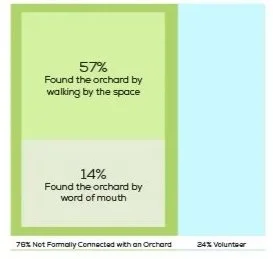
One of the most striking findings was who the orchard visitors are. Most respondents were not formally connected to the orchard as volunteers or stewards. They were neighbors. This matters because it shows that Giving Grove orchards function as public resources rather than program-dependent spaces. People do not need to sign up, attend an event, or even know our organization’s name to benefit. They simply need to live nearby.
That sense of openness is reinforced by how people discover orchards in the first place. More than half of the respondents said they found the orchard by walking past it, while others learned about it through friends or family. Discovery happens through proximity and curiosity, not marketing. This organic engagement is a powerful indicator of accessibility and trust, two qualities that are essential to lasting health impact.
What an orchard makes possible
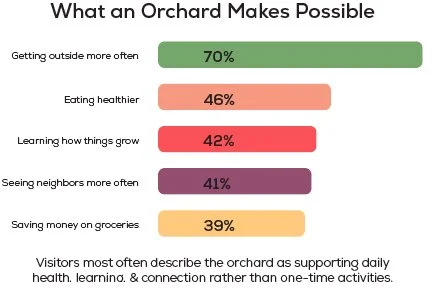
Once neighbors step into the orchard, the benefits are felt in everyday ways. A majority of respondents said the orchard helps them get outside more often. Many also shared that it supports healthier eating, learning how things grow, and seeing their neighbors more frequently. These outcomes may seem simple, but together they form the foundation of physical, mental, and social well-being. More time outdoors. Better access to fresh food. Opportunities for learning and connection. These are not isolated outcomes. They reinforce one another over time.
Everyday Use, Not Just Special Events
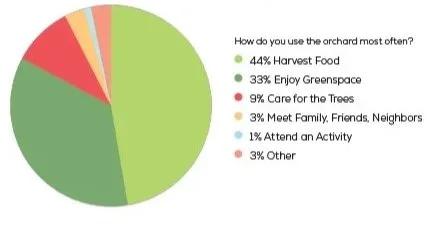
Equally telling is how people use the orchard. Most visitors reported harvesting food or enjoying the greenspace, while far fewer came primarily for organized activities. This tells us that orchards succeed not because of constant programming, but because they are designed to be useful, welcoming, and easy to engage with. They meet people where they already are.
Frequency of visits adds another layer to this story. Nearly a third of respondents said they visit their neighborhood orchard a few times per week. This level of regular use suggests that orchards are not novelties. They become part of a neighborhood’s rhythm. Habits form around them, whether that means stopping by on a walk, checking on fruit, or simply spending time in green space.
What The Giving Grove learned
Neighbors also shared ideas for how their orchards could better serve the community. Requests for clearer educational signage, greater neighborhood awareness, additional berries, and features like benches or play areas point to a desire to deepen engagement. These insights help guide how we design, support, and invest in orchards moving forward, ensuring they continue to reflect the needs of the people who use them most.
From a health perspective, these findings highlight something important about the Giving Grove model. Health does not always require an appointment, enrollment, or intervention. Sometimes it begins with fruit trees planted in the right place. Orchards offer what public health practitioners often strive for: low-barrier, preventative infrastructure that supports healthier behaviors simply by existing.
This Kansas City survey was a pilot, but its success has shaped our next steps. Building on what we learned, The Giving Grove plans to expand this type of neighbor-led surveying to programs across our national network. By listening directly to the people who live alongside these orchards, we can better understand how health, connection, and resilience take root in different communities and climates.
At its core, this work is about trust. Trust that communities know how to use shared resources. Trust that health can grow quietly. And trust that when we plant orchards where people live, well-being follows.
About the author
Sarah Sikich is Director of Marketing & Communications at The Giving Grove, where she leads storytelling, brand strategy, and national campaigns that amplify the power of community orchards. A longtime advocate for urban horticulture, she blends creativity and data-driven strategy to inspire action and celebrate the growing Giving Grove network.