
Urban Orchards, A Quiet Movement
In cities across the country, a quiet movement is taking root in the margins. Behind churches, along schoolyards, beside libraries, and in overlooked corners of our neighborhoods, small urban orchards are growing into something much bigger than food production. They are long-term investments in shade, resilience, dignity, and connection, offering a layered solution to food access, climate stress, and community well-being that often goes unnoticed because trees don’t shout, but they do deliver.
Want to learn more about The Giving Grove straight from your inbox? Consider subscribing to our quarterly newsletter!
Contributed by Sarah Sikich, Director of Marketing & Communications, The Giving Grove
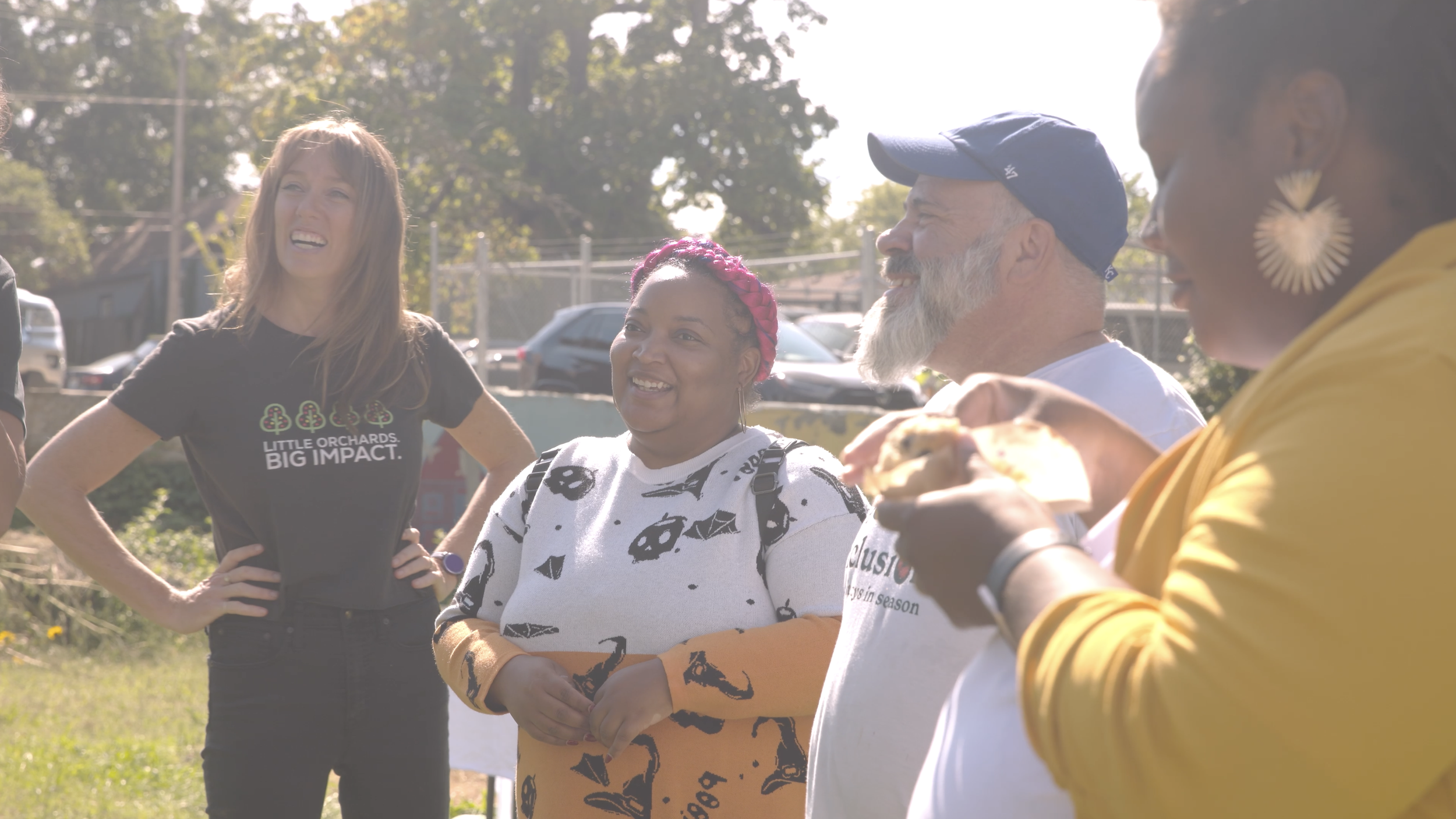
Sikich and volunteers gather in an urban orchard.
In the world of community-based food systems, we often discuss (and excitedly) community gardens, urban farms, rooftop growing, and hydroponics, as well as the various ways people are reclaiming land and feeding their neighbors.
All of these approaches have their place.
All of them matter.
All of them are essential pieces of a more just and resilient food system.
But there’s one solution quietly transforming neighborhoods with almost no spotlight: urban orchards and food forests.
Not industrial orchards.
Not sprawling fruit farms.
The little orchards. The ones tucked behind churches, next to libraries, lining cemetery edges, dotting schoolyards, and filling forgotten corners of the block.
After more than a decade in this work professionally or as a volunteer, I can confidently say:
Urban orchards are one of the most scalable, sustainable, community-rooted interventions we have, and almost no one is talking about them… yet.
“Urban orchards are one of the most scalable, sustainable, community-rooted interventions we have, and almost no one is talking about them… yet.”
So, let’s talk about them…
1. Small Footprint, Big Return
Community gardens and urban farms require dedicated land, and that’s a good thing. They’re incredible hubs of learning, nutrition, and community building.
But the beauty of orchards is that they can go almost anywhere:
the corner of a playground
a sliver behind a church
a forgotten median
a narrow right-of-way
a cemetery edge
the back fence line of a rec center
Orchards don’t replace other food spaces. They add food production to spaces that would otherwise stay empty.
That’s what makes them scalable: there’s no shortage of oddly shaped land in American cities.
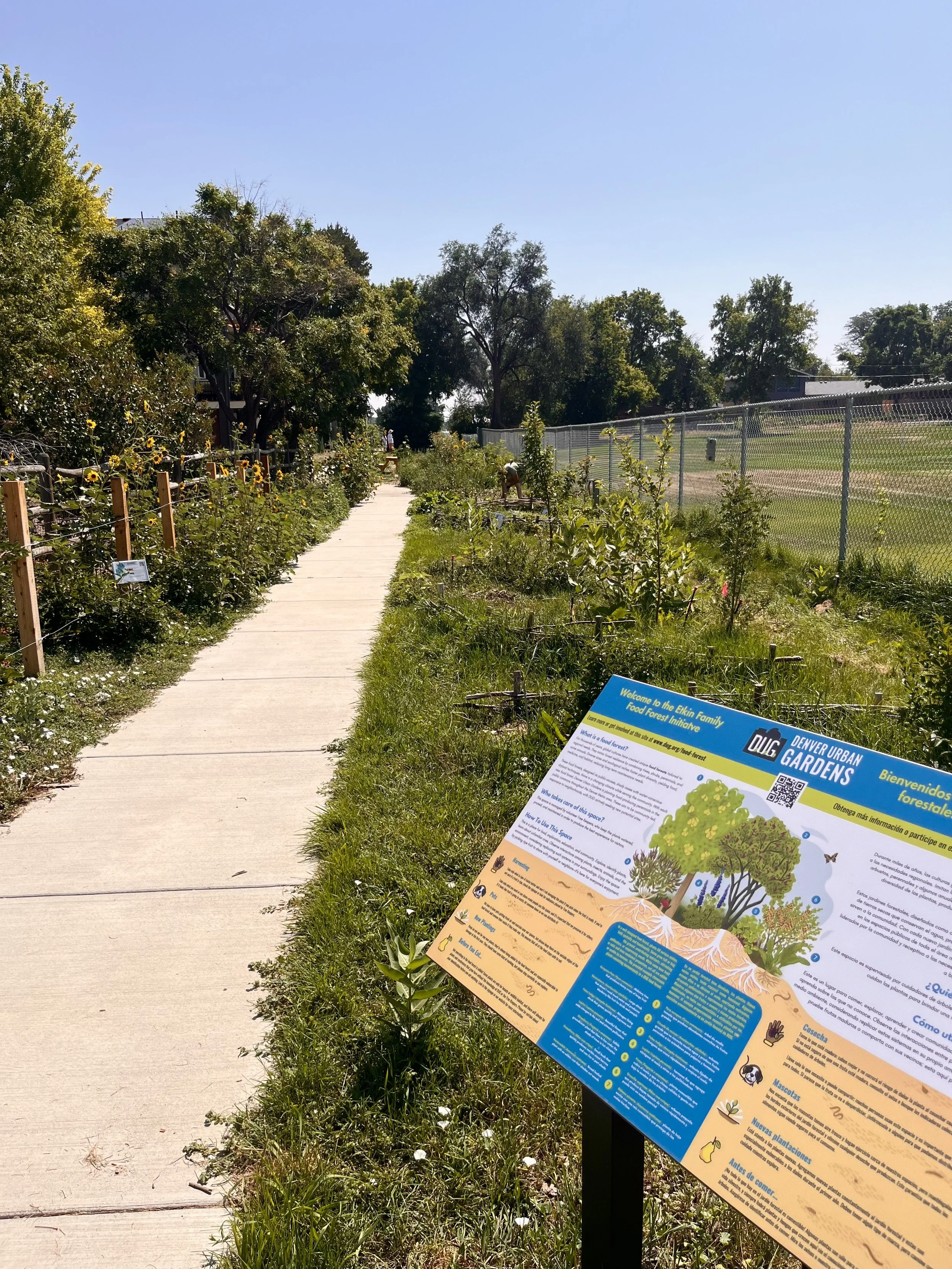
A food forest sits tucked in between a sidewalk and a fence.
2. Orchards Mature into Low-Maintenance, High-Value Assets
Community gardens thrive on seasonal energy and collective stewardship. Urban farms drive local food economies, training, and entrepreneurship.
Orchards complement these spaces by offering something different:
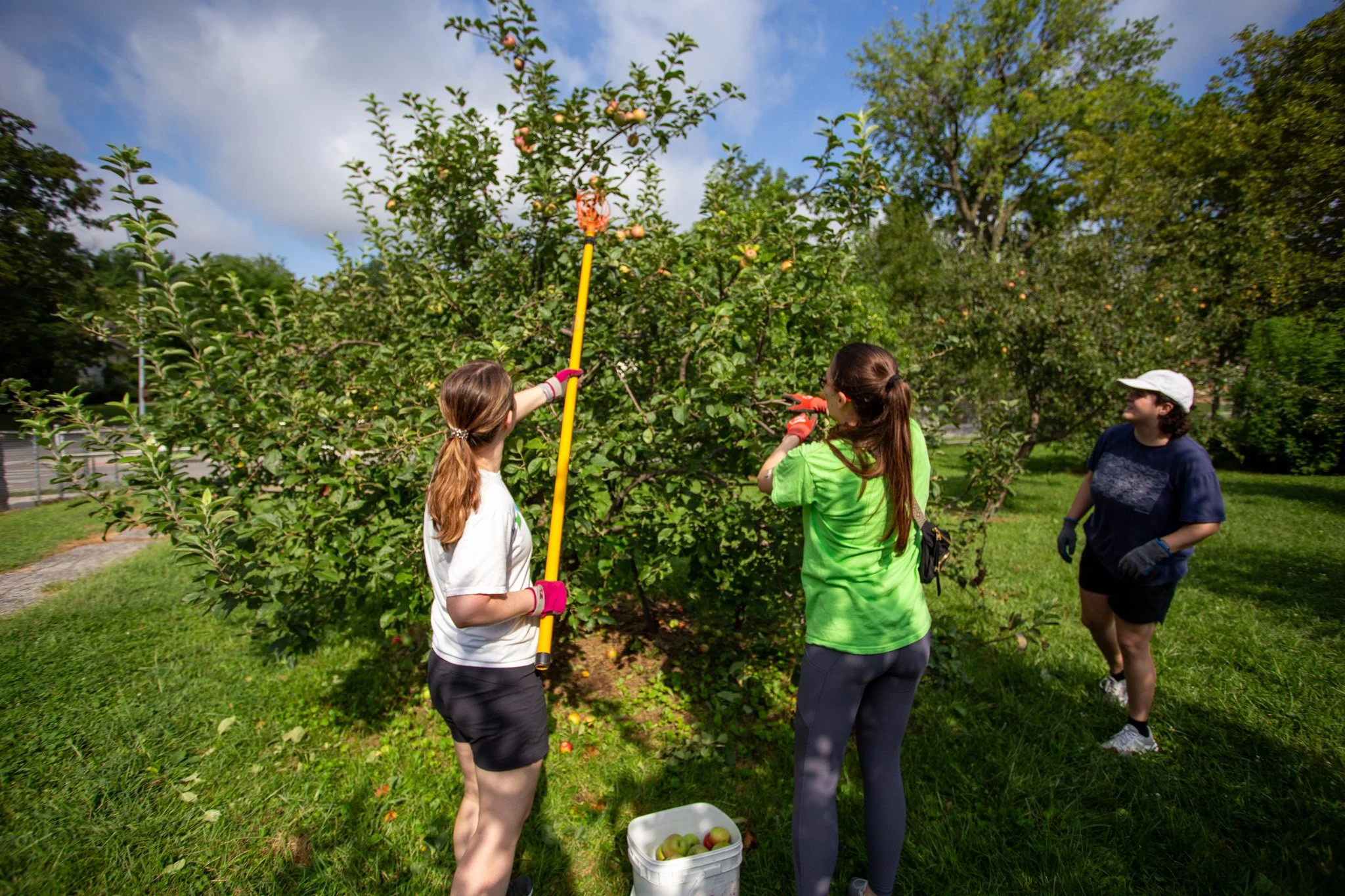
trees produce for 20–30+ years
maintenance decreases as they mature
orchards stabilize ecosystems instead of replanting annually
stewards gain confidence as the orchard ages
Orchards aren’t “better”- they’re simply longer-term.
They become part of the neighborhood’s ecological backbone.
3. One Orchard = A Dozen Layers of Impact
A single orchard can:
1. provide dignified fruit access
2. cool a heat-stressed block
3. absorb stormwater
4. increase tree canopy
5. support pollinators
6. clean air
7. reduce energy use
8. offer shade for schoolyards
9. create pocket parks
10. provide outdoor classrooms
11. boost mental health
12. become a gathering place
This is why orchards scale so easily: they solve multiple challenges at once, without requiring multiple programs.
4. Orchards Strengthen What Already Exists
This is the piece most people miss.
When a neighborhood already has a community garden, adding a small orchard amplifies its impact.
When a school has an outdoor classroom, an orchard transforms it into a living laboratory.
When a church distributes food, an orchard becomes a source of fresh produce.
Orchards aren’t a “replacement strategy.” They’re a layering strategy.
They bring stability and long-term productivity to ecosystems already working hard.
5. Orchards Are One of the Most Cost-Effective Long-Term Interventions
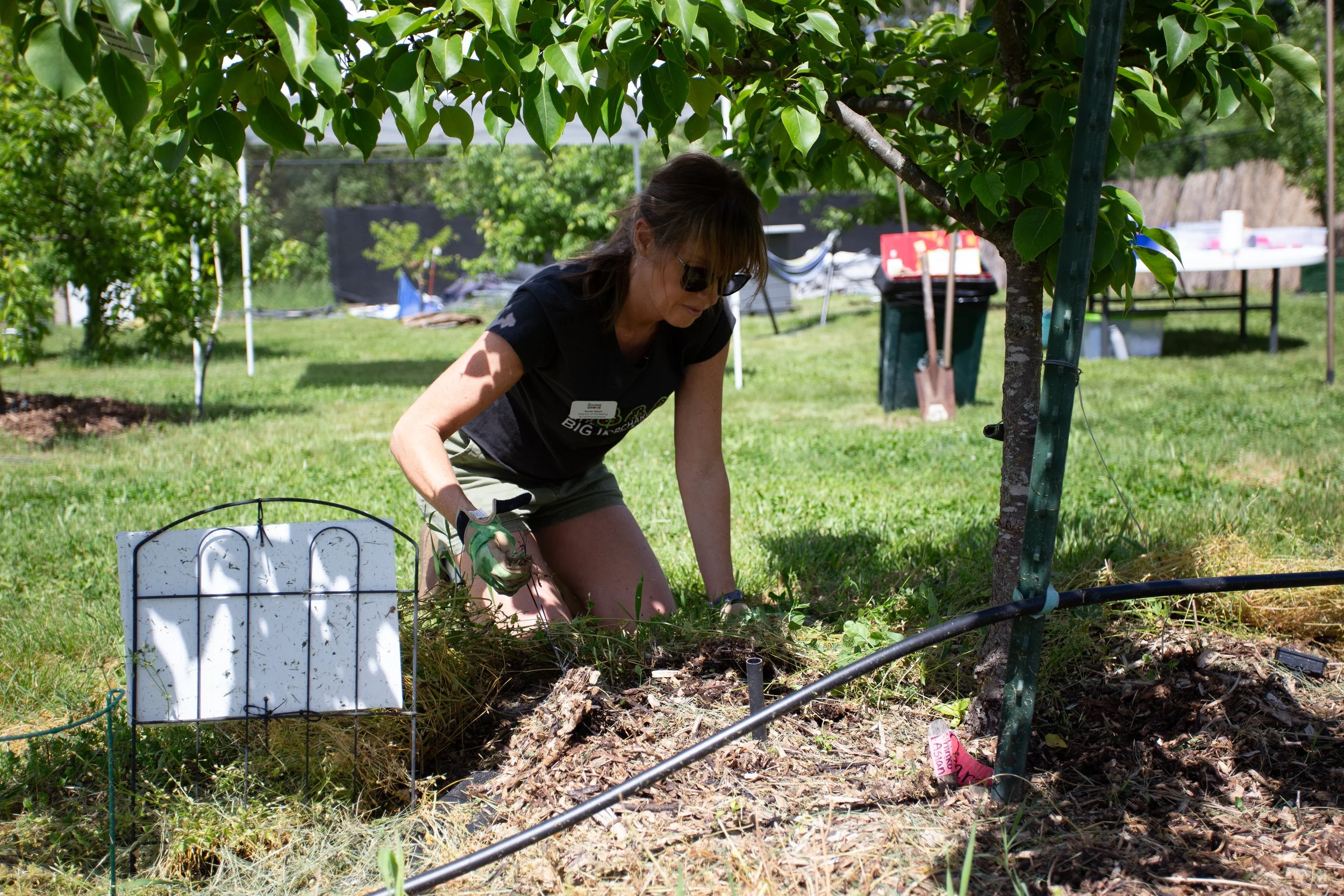
With community gardens and farms, annual budgets renew (and they should). They pay for people, seeds, infrastructure, and programming. Orchards follow a different economic curve: low cost, high yield, compounding value. Once established, orchards produce more and require less. The cost per tree, per pound, per person served is remarkably low over the decades.
They’re not the only sustainable model, but they are one of the few that create a long-term food access asset with minimal recurring cost.
So, Why Aren’t Orchards the Center of the Conversation?
Because orchards don’t look flashy.
They grow quietly.
They don’t need big announcements.
They don’t require constant programming.
They don’t demand a staff of 20.
Orchards are humble. Patient. Generational.
They are exactly the kind of solution that changes everything without shouting.
Final Thought
A healthier food system isn’t built by choosing one approach over another. It’s built by layering them.
Gardens bring people together. Farms build local economies. And orchards? They quietly create fruit, shade, beauty, leadership, resilience, and community for 30+ years right where people already live.
Urban orchards are one of our most scalable, sustainable interventions, not because they are flashy, but because they are everywhere.
Growing quietly. Growing steadily. Growing possibility.
About the Author…
Sarah Sikich is Director of Marketing & Communications at The Giving Grove, where she leads storytelling, brand strategy, and national campaigns that amplify the power of community orchards. A longtime advocate for urban horticulture, she blends creativity and data-driven strategy to inspire action and celebrate the growing Giving Grove network.