
Selecting and Caring for Pawpaws
Each month, we share expert-led training sessions to help community orchard stewards grow and care for thriving fruit trees. On this page, you’ll find a summary of key takeaways and additional resources to deepen your knowledge. Be sure to explore past workshops for even more insights into urban orcharding best practices!
Interested in attending a workshop? Sign up for our workshop series email list!
Presented by Andra Nus, plant breeder and nursery manager at North Carolina State University, and owner of Sleepy Gap Pawpaws
These notes are adapted from Andra Nus’s Giving Grove workshop presentation and the questions captured in its recording. Local climate, soil, tree age and stewardship practices will affect results.
Growing Pawpaws in Community Orchards
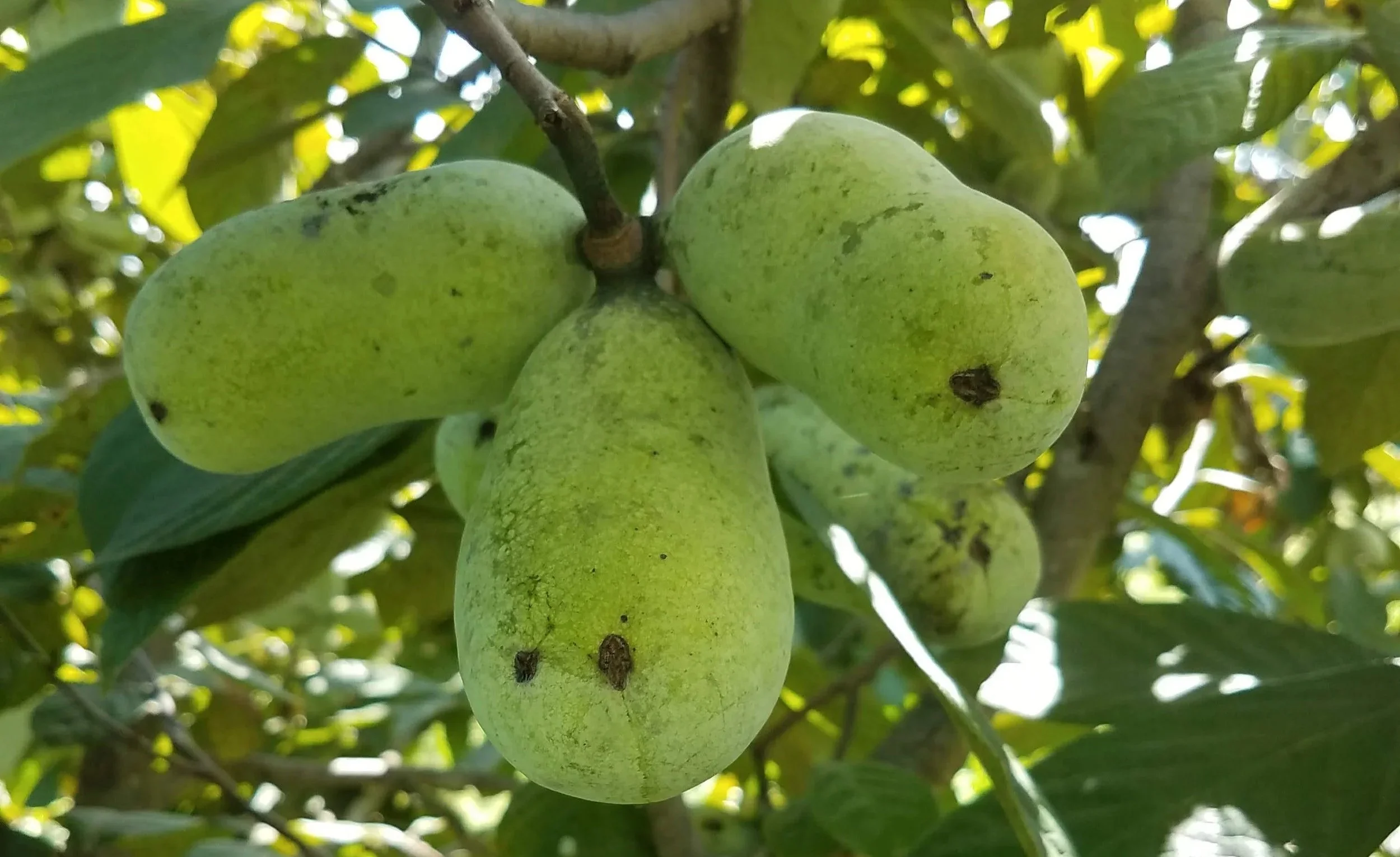
Pawpaw (Asimina triloba) is a North American native fruit tree with broad, tropical-looking leaves and soft, custardy fruit. It can be a rewarding addition to a community orchard when stewards can give young trees consistent care, plant genetically distinct trees for pollination, and organize a harvest plan for fruit that ripens quickly.
Plan the site and the harvest together
Pawpaws naturally grow in moist woodland understories and along streams, but they need drainage: a riverbank can work; standing water cannot. They tolerate sun or shade, though Andra recommends full sun for the best flowering and fruit production. Shade-grown trees tend to make more root suckers and less fruit. Choose fertile, well-drained soil with reliable moisture. Pawpaws tolerate a fairly broad soil pH range (Andra cited about 4.5–7) and recommends that a local extension soil test is the best guide to amendments.
Allow room for mature trees or commit to pruning. Unpruned trees may reach roughly 25–30 feet tall and 20 feet wide. Andra keeps her orchard trees about 8 feet tall and wide to make harvesting manageable. Her closely managed orchard uses 8-foot spacing between trees and 12 feet between rows. A community orchard with less frequent pruning should allow more space. Place trees where stewards can water, monitor ripeness, and collect fruit often during harvest.
Plant and establish young trees
Choose the season thoughtfully. Andra favors fall planting so roots can establish before spring growth. In colder places, plant early enough in fall to allow time before a hard freeze. A fully leafed-out tree planted in spring may need temporary shade while it adjusts.
Protect the roots. Pawpaws develop a long taproot. Dig deeply enough to accommodate the root system without bending or breaking it. Established trees generally do not transplant well.
Water through establishment. Keep up with watering during the first year, adjusting to rainfall and site conditions. Mulch to reduce weed competition, and consider a modest compost top dressing. Avoid guessing at fertilizer needs and test the soil first.
Protect young trunks. Deer usually avoid the foliage, but bucks can damage or kill small trees by rubbing their antlers on trunks. A temporary protective barrier can help.
Plant for pollination
Pawpaw flowers contain both male and female parts, but the female stage generally comes before the pollen-producing stage. For dependable crops, plant at least two genetically different trees: for example, two different named cultivars, a cultivar and a seedling, or two distinct seedlings. Trees arising as suckers from one parent are genetically the same tree and should not be counted as separate pollination partners.
Flies and beetles are among the flower visitors. Flowering can stretch over several weeks in spring, so a late frost may damage some flowers without ending the whole crop. Where fruit set is poor, Andra hand-pollinates. She transfers pollen from a flower in its pollen-producing stage to the shiny, receptive stigma of a flower on a different tree using a small paintbrush. She works through the receptive flowers she can reach rather than targeting a set number. Fruit can develop singly or in clusters from a flower.
Choose trees for your goal
Seedlings provide genetic diversity, but their fruit size and flavor are unpredictable, and Andra estimates they may take about 8–10 years to bear. A grafted, named cultivar offers known fruit characteristics and may begin fruiting in about 4–5 years under suitable conditions. Plan on distinct cultivars if using grafted trees.
Selection
KSU Atwood
KSU Chappell
KSU Benson
Shenandoah
Sequehanna
Potomac
Mango
NC-1
Highlighted Trait
Productive, with mild mango notes
Vigorous growth and large, mild fruit; may need regular pruning
Early ripening, rounded fruit and excellent flavor
Large fruit, fewer seeds and a mild flavor approachable for newcomers
Large fruit, fewer seeds, and a richer flavor
Especially large fruit and vigorous growth in Andra’s orchard
Selected in Georgia; Andra suggested it as a possibility for warmer sites
A Canadian selection to consider for colder sites
These are examples, not guarantees for every region. Ask local growers or extension staff which selections perform well in your climate and obtain trees from a reliable nursery.
Prune and monitor
Andra starts formative pruning around the third year. She trains a central leader, removes broken, crossing or rubbing branches, and lifts low branches for access and airflow. In her managed orchard she keeps trees short enough to harvest from the ground. Remove root suckers that compete with fruit production, especially any shoots arising below a graft union. Pruning frequency depends on the cultivar's vigor and the space available; a fast-growing tree may need attention annually.
Pawpaws generally have fewer pest problems than many orchard fruits, but stewards should still watch for caterpillar damage to small trees, fruit stalk borers, and wildlife eating ripe fruit. Dark spots associated with Phyllosticta can be largely cosmetic, though advanced fruit damage may lead to spoilage. Andra also protects young trunks from winter bark injury with seasonal wraps, removing them after winter. Pawpaw foliage supports zebra swallowtail caterpillars, a benefit to consider when assessing leaf damage.
Harvest and share promptly
Most pawpaws do not reliably change color when ripe. Gently feel each fruit: one ready to pick yields slightly, much like a ripe avocado. A hard fruit picked before ripening begins on the tree may fail to ripen properly. Harvest timing varies by place and season, often falling between late summer and early fall.
The fruit bruises easily and lasts only about 2–3 days at room temperature, or roughly 1–2 weeks refrigerated, according to Andra. Arrange frequent harvest checks and a prompt plan to distribute or process it. The soft flesh has a tropical aroma and flavors people compare with banana, mango or pineapple. Some people experience an unpleasant mouth sensation or do not tolerate the fruit; let participants try a small amount first. Separate the pulp from the large seeds, then freeze the pulp for later use in breads, frozen desserts or other recipes. Andra uses a food mill and makes ice cream with 2 cups each of milk, heavy cream and pawpaw purée plus 1 cup of sugar, mixed and churned in an ice cream maker.
Andra’s Pawpaw Ice Cream Recipe
2 cups milk
2 cups heavy cream
2 cups pawpaw puree
1 cup sugar
Mix all ingredients together and freeze in an ice cream maker.
Q&A
Will two trees pollinate each other? What about three seedlings? Andra said two genetically different trees are generally enough, and three separately grown seedlings should cross-pollinate well. More trees may improve the opportunity for pollination. Several suckers from one original tree do not provide that genetic difference.
How many flowers should we hand-pollinate? Andra pollinates as many receptive flowers as she can reach. She looks for a shiny stigma and transfers pollen from a different tree with a small watercolor brush; pollen adhering to the stigma is a useful visual cue.
Should we grow pawpaws from seed or plant grafted trees? Both can grow into trees. Seedlings add diversity but do not reliably reproduce their parent's fruit quality and can take longer to fruit. Grafted cultivars reproduce known selections and usually bear sooner. For seed propagation, Andra removes the coating around fresh seeds, keeps them moist, cold-stratifies them for about 90 days at roughly 40°F, then allows for slow germination. Seeds must not dry out. Ordinary cuttings do not readily root.
Do pawpaws need pruning every year? It depends on vigor and the desired tree size. Andra prunes vigorous selections such as KSU Chappell and Mango frequently, sometimes annually, while other trees need less work. She begins structural pruning around year three.
Can pawpaws grow in Dallas, Colorado or South Florida? Andra considered Dallas worth trying and suggested the heat-associated cultivar Mango as one possibility. She had no direct Colorado experience and emphasized that any trial there would need dependable moisture. She did not recommend A. triloba for South Florida based on a grower's unsuccessful experience, but suggested exploring other Asimina species native farther south. These were tentative, place-specific observations, not a guarantee of performance.
How long will harvested pawpaws keep, and can we preserve them? Andra estimated 2–3 days on the counter or 1–2 weeks refrigerated. She separates the pulp and freezes it for use over the following months.
What price do pawpaws bring at farmers markets? Andra shared examples from markets she had recently visited, but prices fluctuate by place, season, supply and whether the fruit is a named cultivar. For a community orchard, decide how fruit will be shared before using any single market price in a plan.