
Growing Asian Pears with Matt Bunch
Each month, we share expert-led training sessions to help community orchard stewards grow and care for thriving fruit trees. On this page, you’ll find a summary of key takeaways and additional resources to deepen your knowledge. Be sure to explore past workshops for even more insights into urban orcharding best practices!
Interested in attending a workshop? Sign up for our workshop series email list!
Presented by Matt Bunch, Horticulturist, Kansas City Community Gardens, The Giving Grove
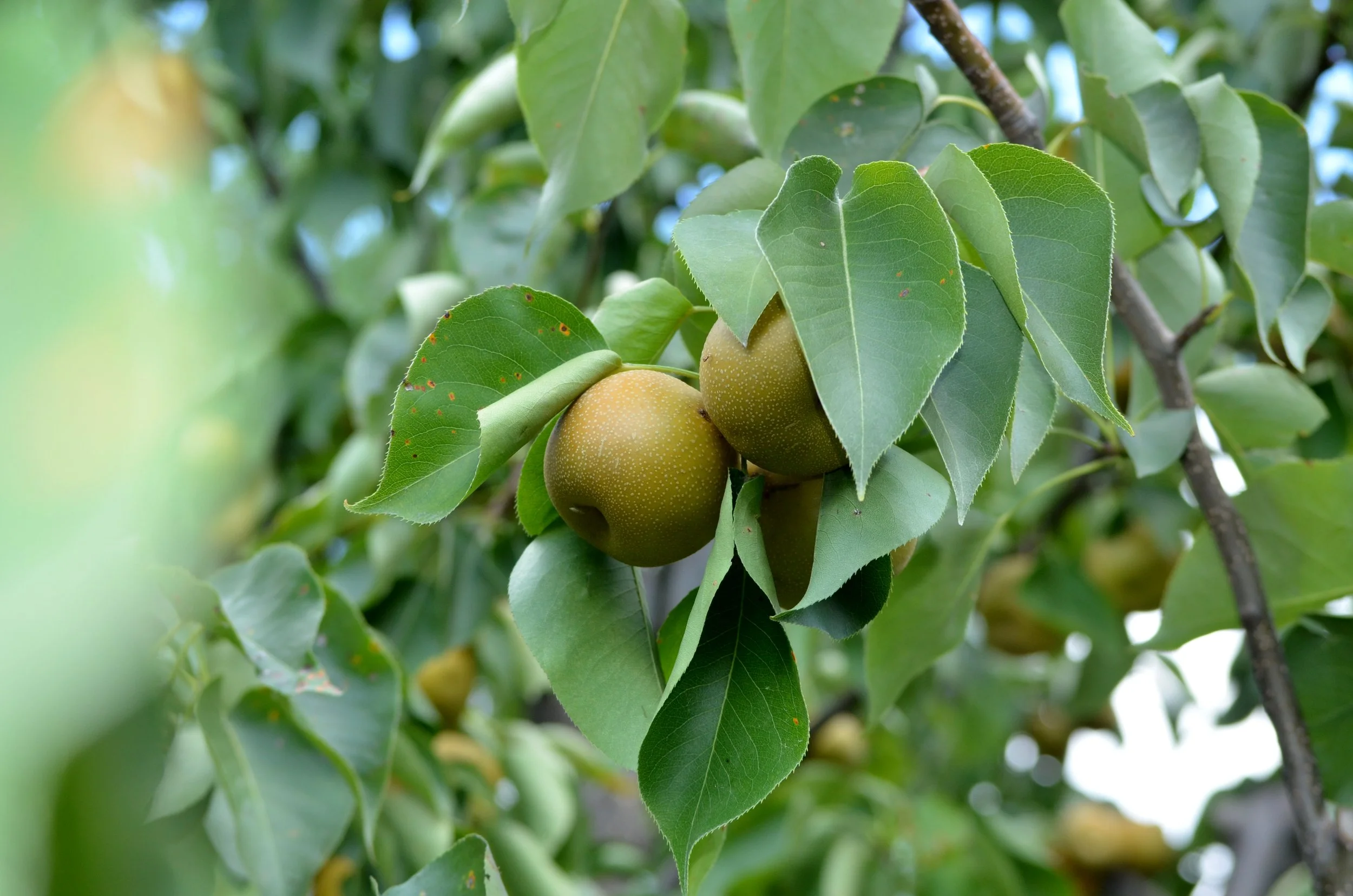
Asian Pears are a productive, attractive fruit tree that can thrive in many community orchards and climates. They are known for their crisp texture, sweet flavor, and ability to produce fruit at a relatively young age. With proper cultivar selection and maintenance, they can be an excellent addition to orchards across much of the United States.
History
Asian pears have been cultivated in China for at least 3,000 years and were introduced by Japan around 800 CE.
Today, nearly 3,000 cultivars are grown worldwide.
Most of the cultivated varieties belong to one of these three species:
Pyrus serotina (Sand Pear/Asian Pear)
Pyrus ussuriensis (Siberian or Chinese Pear)
Pyrus x bretschneideri (White or Duck Pear)
Climate & Site Requirements
Suitable for USDA Hardiness Zones 4-9 (depending on cultivar and rootstock)
Prefer soil pH between 6.0 – 7.5
Flowers earlier than European pears
Most varieties benefit from cross-pollination, although some are partially self-fertile
Begin producing fruit as early as the third growing season
Typical mature height ranges from 15-30 feed depending on pruning and rootstock
Trees can often be planted 10-12 feet apart
Many rootstocks tolerate heavier clay soils better than other fruit trees
Fruit ripens on the tree rather than after harvest
Common Pests & Diseases of Asian Pears
Several pests and diseases should be monitored throughout the growing season.
Diseases
Fire blight (the most significant concern): https://www.givinggrove.org/fire-blight
Pear rust: https://www.givinggrove.org/pear-rust
Fabraea leaf spot: https://pnwhandbooks.org/plantdisease/host-disease/pear-asian-pyrus-spp-fabraea-leaf-spot
Pseudomonas (often associated with cold injury): https://pnwhandbooks.org/plantdisease/host-disease/pear-pyrus-spp-pseudomonas-blossom-blast-dieback
Insect & Pests
Pear psylla: https://www.givinggrove.org/pear-psylla
Leaf curl midge: https://pnwhandbooks.org/insect/tree-fruit/pear/pear-pear-leafcurling-midge
Leaf blister mite: https://www.givinggrove.org/twospotted-spider-mite
Codling moth: https://www.givinggrove.org/codling-moth
Good sanitation, thoughtful pruning, and timely integrated past management practices can significantly reduce problems.
Asian Pear Rootstocks & Cultivars
Rootstocks
Calleryana (Pyrus calleryana) – adaptable to wetter soils; hardy to Zone 5a
Betulifolia (Pyrus betulifolia) – hardy to Zone 4; vigorious and productive; may produce root suckers
OHxF97 – semi-standard size with good fire blight resistance
OHxF333 – more dwarfing with good fire blight resistance
Recommended Cultivars
When selecting cultivars, consider: disease resistance, harvest season, fruit size and flavor, cold hardiness, and storage potential.
Cultivar performance varies by region, but commonly recommended varieties include:
Chojuro
Shinseiki (New Century)
Shinsui
Yoinashi
Shinko
Nijisseiki (20th Century)
Korean Giant (Olympic/Danbae)
Seuri
Kosui
Niitaka
Reddy Robin
Juicy Jewel
Training & Pruning Asian Pears
Asian pears naturally grow upright and benefit from early structural training.
Best practices include:
Train to the central leader or candelabra-style structure.
Use limb spreaders while branches are young to create wider branch angles.
Remove very narrow branch crotches early (less than 45 degrees).
Maintain tree height around 10-12 feet for easier harvesting.
Limit dormant pruning on mature trees to avoid excessive upright growth.
Most routine pruning can occur during the summer.
Harvest & Storage of Asian Pears
Unlike European pears, Asian pears are harvested fully ripe.
Harvest tips:
Pick fruit when the background color changes from green to yellow or orange (depending on cultivar).
Handle carefully to avoid bruising.
Refrigerate fruit without washing.
Chilling improves both texture and flavor.
Typical storage life:
Early-season cultivars: approximately 2-3 months
Late-season cultivars (Such as Korean Giant or Seuri): approximately 4-6 months
Culinary Uses of Asian Pears
Asian pears are excellent for:
Fresh eating
Salads
Stir-fries
Stews
Meat marinades and tenderizing
Some kimchi recipes
Because of their high water content, they are generally less suitable for baking or preserves than European pears.
Additional Resources:
Books
Uncommon Fruits Worthy of Attention by Lee Reich
The Holistic Orchard by Michael Phillips
Online Resources
Pacific northwest Plant Disease Management Handbook (Asian Pear Cultivar Susceptibility) https://pnwhandbooks.org/plantdisease/cultivar-tables/pear-asian-cultivar-susceptibility
Specialty Produce – Chojuro Asian Pear: https://specialtyproduce.com/produce/pears/asian/cho_juro_7211.php
About the Presenter
Matt Bunch’s love for plants and gardening grew from the gardens of his parents and grandparents. Schooled as a history major, Matt has worked in the horticulture profession since 1994 in retail, municipal, and public garden capacities. From 2004 to 2013, Matt was with Powell Gardens (Kansas City’s Botanical Garden), first as a Native Plant Landscape Specialist, then as the Horticulturist for the 12-acre Heartland Harvest Garden edible landscape. Matt continues to garden at home with his family, is always in search of the next champion tree, and by informal count, has planted close to 10,000 trees. Matt has been with The Giving Grove since 2013.