School Orchards
Each month, we share expert-led training sessions to help community orchard stewards grow and care for thriving fruit trees. On this page, you’ll find a recorded workshop, a summary of key takeaways, and additional resources to deepen your knowledge. Be sure to explore past workshops for even more insights into urban orcharding best practices!
Interested in attending a workshop? Sign up for our workshop series email list!
Best Practices:
Community Resource Sharing – Work with local organizations and businesses to expand your orchard community can help with donations of materials or services to lighten the maintenance tasks throughout the year
Utilize Orchard-Based Curriculum – See our section below for list of resources on lesson plans and orchard-based curriculum based upon students’ age groups
Provide an Orchard Caretaker Manual – Whether utilizing Michael Phillips’ “Holistic Orchard” or Susan Poizner’s “Growing Urban Orchards” it’s very helpful to have a base of knowledge to provide your stewards as they are learning all about fruit tree care. Stewards as part of the Giving Grove Network have access to a specific manual, contact your local program manager for access.
Tool kits – Equipping stewards with the tools that they need to succeed. A basic tool kit would include a pair of bypass hand pruners, loppers for larger branches, a hand saw, a handheld (or backpack) sprayer for applying holistic spray, a harvest pole and container and orchard ladder can be helpful tools for taller trees.
School visits – The wider engagement you can achieve in your orchard, the more resources you have available. Contact your local Giving Grove affiliate organization to arrange a site visit or work with local gardening groups and community gardens in your area to get an extra hand completing orchard maintenance tasks throughout the growing season.
Invite Guest teachers/workshops – Collaborate with local gardening groups, community gardens, extension office and community experts to bring in guest speakers to maximize the use of school orchard space. Also utilize Giving Grove Education Resources & Workshops as an additional source of information for your school orchard.
Create Orchard Maps – Creating a map of your orchard allows you to capture historical information about your orchard. You can also use it to mark the date your trees were planted, pruned, sprayed, planted and in case you lose a tree label, keep track of which varieties were planted where.
Produce Maintenance Logs – Allows you to keep track of activities completed in the orchard season and tailor your classroom curriculum to match the best activity of the season, depending upon the age group of your students.
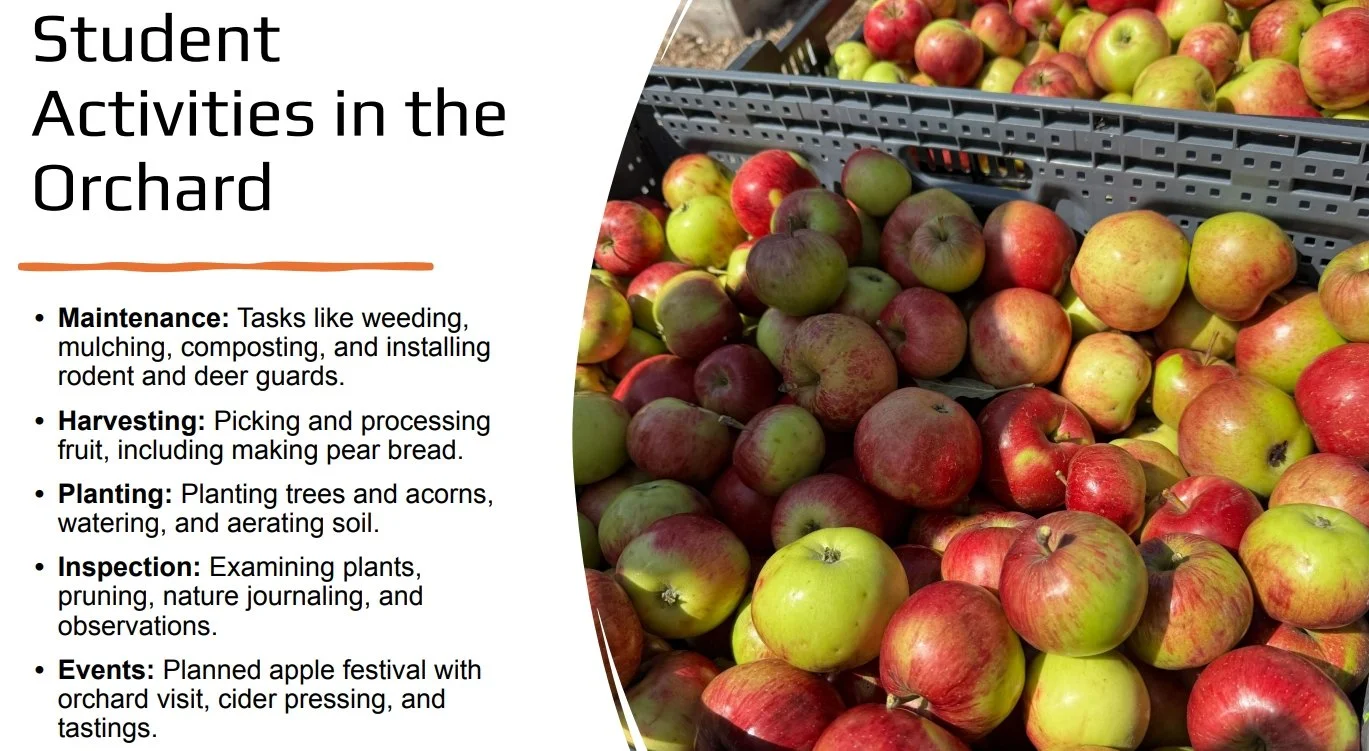
Maintenance Ideas for Students:
Weeding Under Trees
Spreading Mulch
Watering Trees (Using Small Cups or Containers)
Planting Seeds
Observation Activities, such as birdwatching, orchard journaling or bug searches
Harvesting & Weighing Fruit
Installing Winter Tree Guards
Orchard Sign Making
Activities for Older Students:
Serving as “Orchard Stewards” paired with elementary students
Pruning Trees
Painting Trunks for Winter Protection
Sorting & Processing Produce (into Cider or Jam)
Engaging Community:
Work with local organizations, businesses, places of worship, and other community groups to conduct an map of your community-based assets (See our Workshop: “Tips to Engage Community in Your Orchard”)
Connect with more than one member of school staff, facilities maintenance, and/or administration to have multiple points of contact for orchard decisions. Engage those participants in important decisions, such as regular maintenance plans, orchard location placement
Celebrate events in the orchard on a regular basis, such as an orchard birthday, harvest party or Wassail (Winter Celebration) to thank volunteers and build moreFood Sources
Provide nectar, pollen, and prey insects year-round
Aim for 3+ species blooming per season from diverse families
Use native plants suited to soil, sun, moisture
Include grasses/sedges for nesting and larval food
Cover crops = “green manure” for soil fertility, weed suppression, erosion control, pollinator support
Challenges:
Inherently, school orchard sites may be challenging to navigate because of multiple factors, like teacher turnover, changes in administrative staffing or permissions and summer breaks. Make sure to read the Green Schoolyards for America’s article, “Making the Academic Case for Schoolyard Forests” as you engage community members in your building support for your orchard.
Communication within Schools – Establish contact at multiple points within the school community
Telling the Story
Recruiting Orchard Stewards
School Breaks - Engaging Community,
Seasonal maintenance as learning opportunities
Student & community involvement models
After-school groups and ecology-based school clubs
Sustainability: who maintains it over summer breaks?
Weekly Sign-Up Sheet (Amongst School Families) for Maintenance Tasks
Coordinate with Maintenance Staff and provide support and training resources, if necessary
Curriculum Resources:
Green Schoolyards
Educator Resources: Making the Academic Case for Schoolyard Forests
Giving Grove Curriculum Materials
Philadelphia Orchard Project Curriculum Resources (All Ages)
ReTreeUS- The Power of Pollination (Grades 5-6)
Testimony:
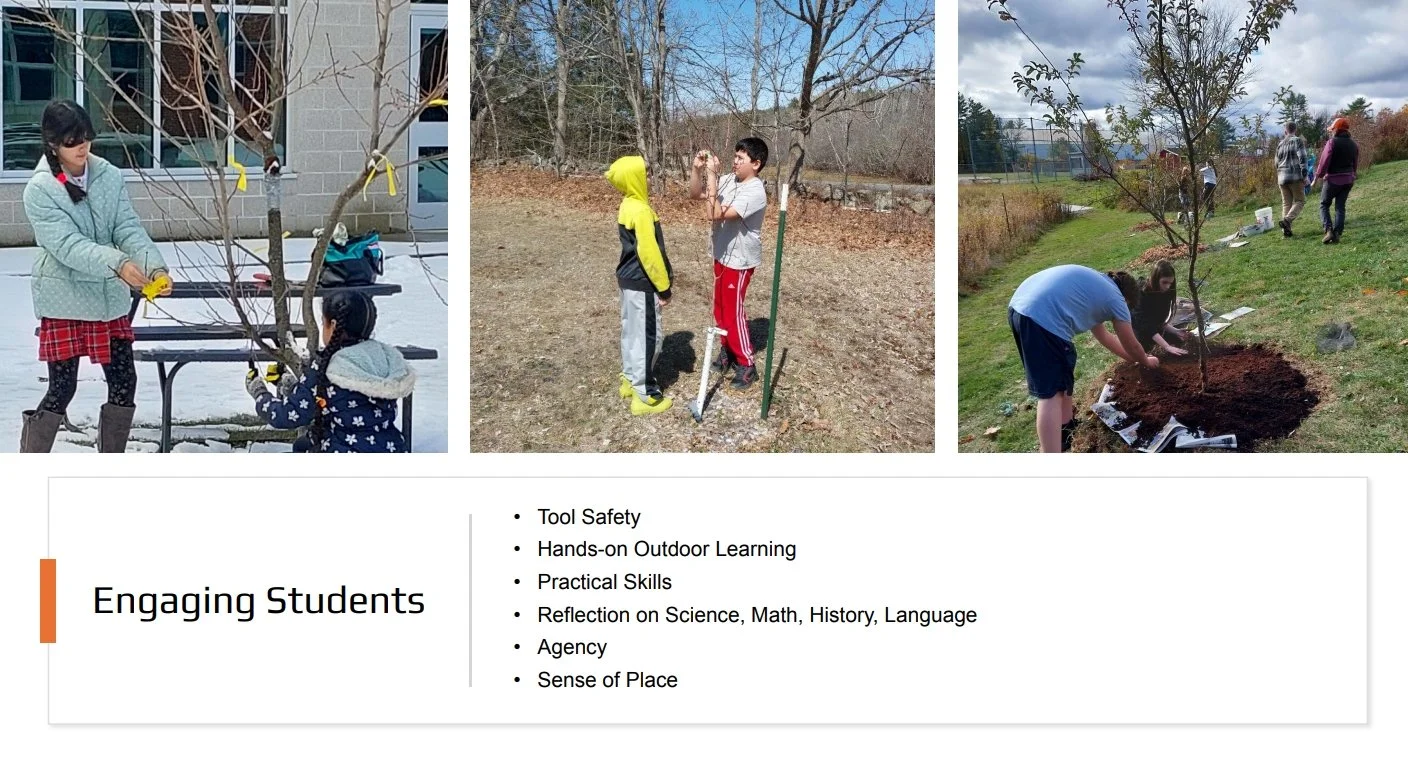
“I always get to hear more language out of my new Mainers when I bring them outside to our orchard. I also get to see sides of them I've never seen before. Picture a sixth grade girl hauling buckets of water, muscles bulging with pride and joy on her face.
Or a fifth grade student who single handedly picked up the pear tree and carried it to the hole she'd just dug. A student I had been having trouble connecting with at the beginning of the year is now better behaved and working as hard as he possibly can.
He loved going outside to work. Working together side by side with me and his friends made a amazing. All were excited to take care of the trees and eat the fruits of their labor. Making and eating apple crisp was a class favorite.”
-Participant from ReTreeUS Program
Resources:
A is For Apples (Grades K-2)
https://agclassroom.org/matrix/lessons/374/
Treemendous Fruits (Grades 3-5)
https://agclassroom.org/matrix/lessons/873/
Green Schoolyards
Forest Resource Library - https://www.greenschoolyards.org/forest-resource-library
Giving Grove Curriculum Materials
ReTreeUS The Power of Pollination (Grades 5-6)